
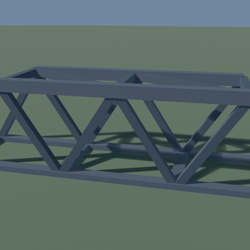
Gusset
Drag two anchors to the ends. Gusset builds a Warren, Pratt or Howe truss cut to that exact span.
What you get
Choose the diagonal angle, not a guessed bay count: Gusset checks the whole-number possibilities and divides the span into equal bays. Add width for two planes, floor beams, struts and top bracing.
How it holds up
Equal bays keep every diagonal consistent instead of leaving an odd last bay or scaling the member thickness. Odd Pratt and Howe counts cross the middle bay to remain symmetric.
What it does not do
Diagonals below 20 degrees or above 75 degrees are refused with an explanation of what would make the geometry work.
The listing, word for word
Drag two anchors to the two ends. Press Play. A truss is built between them cut for THAT span.
A TRUSS IS A SPAN DIVIDED INTO EQUAL BAYS. That is what makes every diagonal the same length. Stretch a fixed-length truss to 137 studs and either the last bay is the odd one out, or the whole thing is scaled and the members get fatter. Both read as wrong at a glance.
YOU DO NOT PICK THE BAY COUNT, THE ANGLE DOES. Nobody knows how many bays they want; everybody knows a shallow-webbed truss looks wrong. Say the angle and the count follows - and it is the BEST whole number for it, checked against every other.
THREE STYLES. Warren offsets its top nodes half a bay, needs no verticals, and every diagonal is identical. Pratt's diagonals fall towards midspan; Howe's rise. An odd bay count crosses its middle bay to stay symmetric.
GIVE IT A WIDTH AND IT IS A BRIDGE: two planes, floor beams, struts, top bracing.
It refuses diagonals below 20 degrees or past 75, and says what would fix them.