
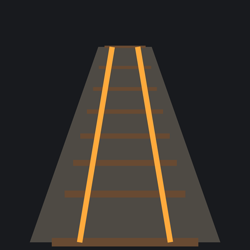
Ballast
Place a few points across your map. Ballast lays one continuous railway along them: stone bed, sleepers and two rails through every curve and climb.
What you get
It solves joined straights, circular curves and parabolic grades before drawing the parts, so error cannot accumulate from one prefabricated piece to the next.
How it holds up
On the measured 640-stud example, the gauge held within 3e-14 studs, the rail gap was zero and the heading never stepped.
What it does not do
A corner too sharp or a grade too steep is refused before building, with the measured constraint and the widest curve or grade that would fit. Drag the points and press Play to rebuild.
The listing, word for word
Place a few points across your map. Ballast generates a railway from solid ballast-bed Parts, sleepers and two segmented rails made of rectangular Parts that follow every curve and climb.
One continuous line replaces a pile of premade pieces. Straights join circular curves; grades join parabolic transitions. On the 640-stud proof line, gauge error stays within 3e-14 studs, the rails have no gaps and the solved alignment has no heading jump at its joins.
Bad inputs are refused with a useful number. A sharp corner reports the widest curve that fits; a steep climb reports the measured grade.
Drop Ballast in, press Play, drag the control points and rebuild. Output uses ordinary Parts and keeps the configured materials.
Gallery disclosure: polished mountain scenes are illustrative finished-world context. Ballast outputs the track only: solid bed, sleepers and two rails. Scenery, rock texture, fasteners, trains and signals are not included.